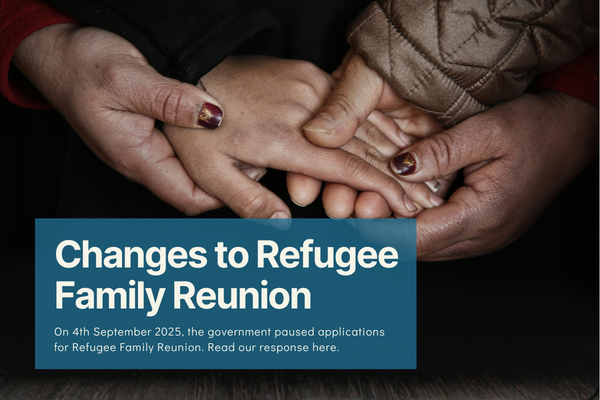
On 4th September 2025, the government suspended applications for Refugee Family Reunion. Refugee Family Reunion is a visa route for people with Humanitarian Protection and refugee status to apply to reunite with their immediate family, usually their partners and children, in the UK.
Until new eligibility requirements are announced in spring 2026, people with refugee status can still apply via the family visa route, also available to British citizens and those with settled status. However, the main applicant must earn a minimum of £29,000 a year, prove their knowledge of English language and pay an application cost of £1,938 and the Immigration Health Surcharge (which for most individuals aged over 18 is £1,035 per year) per applicant.
Families belong together
Family Reunion is a safe and legal route for families to reunite, mainly used by women and children, often after experiencing traumatic circumstances and long periods of separation. Due to the dangerous journeys people undertake to claim asylum, individuals who claim asylum are predominantly men, who are often forced to leave their families behind in order to go ahead and seek safety. Once they are granted refugee status, they can apply for Family Reunion Visas to safely bring their family to the UK. This route is enshrined in Human Rights Law, via the Right to Family Life, showing the internationally recognised importance of this route, allowing families to reunite after experiencing difficult circumstances.
Reasons why Family Reunion Applications have been paused
1. Impact of the asylum backlog on local services
The Government reported that there had been an increase in the number of applications for family reunion between 2024 and 2025. Due to the clearing of the asylum backlog during this period, there has also been an increase in people eligible to apply for family reunion. This increase has compounded with the UK’s current housing crisis, especially affecting people recently granted refugee status who struggle to secure housing after leaving asylum accommodation. The Government has argued that councils have been supporting families who had been sponsored for family reunion very soon after the main applicant had received refugee status. Therefore, individuals were not often self-sufficient and could not support family members after they arrived in the UK, which has led to extra strain on local councils’ resources.
However, of the refugee family reunion visas granted in the last year, two-thirds were to people from countries facing severe instability, such as Sudan, Afghanistan, Iran and Eritrea, and 92% of these were to women and children (Source: GMIAU). Previously, refugee family reunion claims took on average between six to twelve months before a grant of leave to enter. It was often unclear to the applicant exactly when visas would be approved by the Home Office, making it difficult to make long-term plans. Understandably, for people who have often been separated from each other for some time, the desire to reunite as soon as possible is a natural one.
2. Stricter immigration policies and future new requirements
The pause to family reunion applications is in line with the Government’s wider tightening of the immigration requirements, set out in its recent Immigration White Paper, and subsequent Asylum and Returns Policy Statement. The Government has argued for family reunion requirements to be in line with those for British Citizens. The Prime Minister, Keir Starmer, recently argued that family reunification rights act as a “pull” factor to the UK, and people granted asylum must now “earn” their settlement in the UK. Refugees will no longer have the automatic right to apply for reunion visas for their families, and will have to fulfil new requirements to do so. At Boaz, we believe that people should not have to earn the right to reunite with their loved ones.
Possible future requirements
We do not know what the future requirements for family reunion applications might be. In any case, any future iteration is likely to be much stricter. The British Red Cross has suggested this may include:
- A mandatory delay before people with refugee status can apply for refugee family reunion;
- An application fee and Immigration Health Surcharge attached to each application;
- A minimum income requirement for the sponsor, or maintenance and accommodation requirements;
- English language requirements for the family members applying to join the sponsor.
The impact of the suspension
The suspension of this safe route to seek sanctuary in the UK may lead to more dangerous journeys undertaken by women and children that would previously have been eligible for a family reunion visa. Safe Passage International believes this will lead to more children crossing the Channel, especially those who may be sleeping rough in Calais and have family members already in the UK.
The impact on people supported by Boaz
The news of the suspension of the family reunion visa has devastated many people with refugee status supported by Boaz. The short time period between the announcement of the suspension of applications and its implementation meant that both staff and those supported by staff had little time to respond to the changes. Many people who were ready to apply for family reunion have now missed the deadline. They were working and saving money with the goal to reunite with their families here in the UK, but had not heard the news about the suspension. When they were informed, they were devastated.
Uncertainty and the impact of waiting
The uncertainty about the future of family reunion and the lack of clarity around the possible new requirements has led to a lot of confusion and misinformation for people who were hoping to apply. The suspension of visa applications has now made it more difficult for people with refugee status to apply, leading to more barriers for them to be reunited with their families. Now, they will have to wait even longer before applying and fulfil more rigorous requirements, prolonging the period that they are separated from their families. This is especially pertinent as research has shown that people with refugee status often struggle to access employment and English language skills in the UK at a higher rate than other migrants. Whatever the new requirements may be, the uncertainty and vague timescale regarding any future iteration of family reunion leaves a lack of clarity, where misinformation can thrive.
The wait before the family reunion visa route is reopened and the impact of new requirements will have a further impact on people with refugee status supported here at Boaz.
The financial impact
People with refugee status will continue to send money to their families abroad for a longer period, instead of being reunited with them. This will have an impact as people with newly granted refugee status are often on an incredibly stretched income and may have to make difficult decisions about paying rent or supporting their families.
The impact on wellbeing
The uncertainty about family reunion visas and the separation from loved ones, compounded by the periods of waiting and uncertainty people have already faced in the asylum system, undoubtedly impacts people’s mental and physical health. The feeling of uncertainty about their future in the UK whilst separated from their family and the increased barriers to reunite with them is likely to impact the wellbeing of those with refugee status, Furthermore, any previous trauma an individual may have, and the worry for family members still living in vulnerable or dangerous situations overseas, is likely to impact on a person’s mental health.
In conclusion, whatever the future changes to refugee family reunion visas may be, the suspension of the scheme leaves at least six months where people with refugee status cannot apply, prolonging the separation from their families. The introduction of more stringent requirements to apply will increase the barriers for people with refugee status to be reunited with their loved ones, impacting their wellbeing and encouraging more people to take dangerous journeys to the UK. These barriers, on top of a previous period of uncertainty while in the asylum system, is another way to make displaced people feel isolated in our communities. Instead of feeding into the current anti-immigration rhetoric and division, we want to speak out in defence of refugee family reunion.
Do you agree? Join us in supporting Safe Passage’s campaign, Together Not Torn, and email the Home Secretary to stand up for families’ right to be together.