Attempts to end homelessness must include individuals like those we support at Boaz
A statement on the Prime Minister’s drive to end street homelessness


We welcome the Prime Minister’s announcement in recent days to offer all rough sleepers in England a route off the streets by Christmas, as well as his broader commitment to end street homelessness.
As an organisation that has worked in Greater Manchester for more than twenty years supporting people who have experienced homelessness after claiming asylum, we continually see the long-term detrimental effects that homelessness, and destitution more broadly, has on people and we welcome what we see as a genuine desire by the Prime Minister to end it.
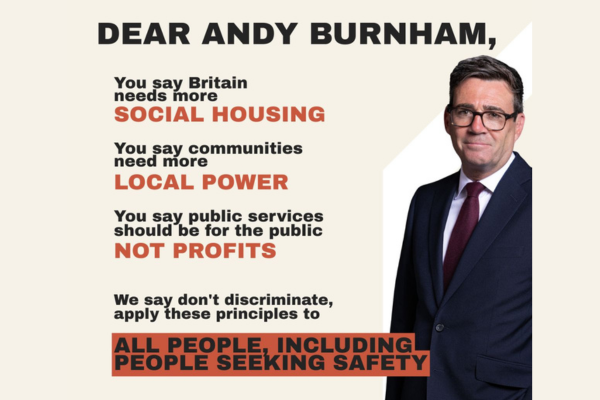
During his time as Mayor of Greater Manchester, Andy Burnham pioneered A Bed Every Night (ABEN); a GM-wide scheme designed to ensure that anybody sleeping rough has access to safe, emergency accommodation. Crucially, recognising the need among people with insecure immigration status, this scheme has always been available to individuals who are ordinarily unable to access emergency homelessness accommodation owing to their ‘no recourse to public funds’ (NRPF) status, which denies people without settled status access to most public benefits.
Likewise, the Everyone In initiative, pioneered by the Government during the Covid pandemic, included emergency accommodation for everyone sleeping rough. Councils were instructed to include people with NRPF, something that Greater Manchester Combined Authority (GMCA) explicitly did in partnership with local authorities, housing providers, voluntary and faith sector organisations and others.
As an organisation, Boaz receives funding through GMCA (previously under Andy Burnham’s leadership) to deliver support through the Restricted Eligibility Support Service, offering person-led support, advice and signposting for people experiencing or at risk of homelessness because of their immigration status. We receive additional funding through GMCA to deliver the Refugee Homelessness Prevention Project, working across several boroughs in Greater Manchester to support people with refugee status who face homelessness. Funding for both pieces of work demonstrates a clear understanding at a regional level from the now Prime Minister that the asylum and immigration system is a driver of homelessness in our region.
If the Prime Minister is serious about ending rough sleeping and homelessness more broadly, we must see a change in policy direction from the Home Office. The Asylum and Immigration Bill, currently making its way through Parliament, would see people granted refugee status for 30 months (as opposed to 5 years) and repeatedly reassessed over a 20-year route to settlement. This would undoubtedly lead to much greater levels of destitution and homelessness (owing to debt from repeated legal and application fees, insecure work and housing instability).
Furthermore, the Government’s earned settlement proposals (announced last year, before Andy Burnham became Prime Minister), if introduced, plan to make it significantly harder for people to be granted indefinite leave to remain (ILR); extending the standard route of 5-10 years to 15, 20 or even 30 years. The proposals, which were subject to a public consultation which we are awaiting the results of, will inevitably lead to significantly increased levels of homelessness and destitution. Our 2024 Slow Violence report evidenced the long-term detrimental impact, including homelessness, of precarious or irregular immigration status.
Additionally, the decision by the Home Office to reduce the extended 56-day move-on period for newly granted refugees to 42 days will drive up levels of homelessness. The Government’s own evaluation of an extension to the move-on period to 56 days identified ‘unambiguous support’ for it. Multiple bodies of research, including our 2025 From Surviving to Thriving report, have shown that a 28-day move-on period is a contributory factor in people experiencing homelessness.
All attempts to end rough sleeping and homelessness must include people who are ordinarily excluded from mainstream support owing to their immigration status. While this must obviously include practical support provision, it must also mean that the lived experiences of people who have become homeless owing to their immigration status are properly understood.
Home Office policies that will continue to drive up levels of homelessness and destitution must be replaced by policies that are grounded in implementable reality. They must enable individuals to integrate and rebuild their lives in a reasonable and humane timeframe and allow for personal, as well as societal, flourishing.