In response to the recent changes to asylum and immigration rules announced by the Government, Boaz Trust’s Advocacy Manager, Amy Merone, and Chief Executive, Ros Holland, write about the devastating consequences they fear for people across Greater Manchester.
As a charity that has worked with people for more than twenty years facing destitution after claiming asylum, we are deeply concerned that recent changes to asylum and immigration rules announced by the Home Secretary will lead to growing levels of poverty and homelessness across Greater Manchester.
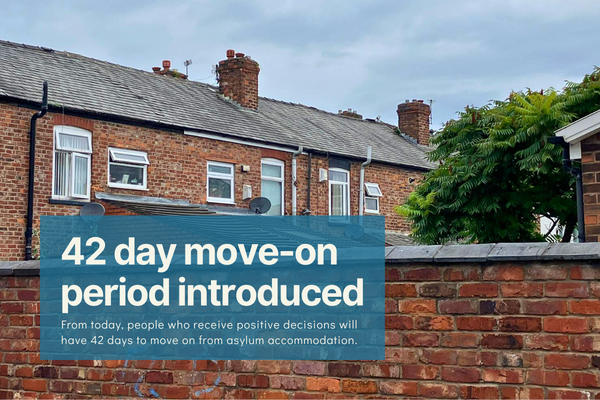
Once such change is the now 42-day move-on period for people newly granted refugee status. We have long campaigned with others for a 56-day move-on, informed in part by research we conducted last year with people who had experienced homelessness after being granted refugee status. Our research clearly demonstrated that giving people extra time and specialist support once they received status to set up a bank account, access Universal Credit and find housing reduced the likelihood of them becoming homeless.
While we of course welcome any extension to the 28-day move-on period, this was a missed opportunity to do something meaningful to prevent homelessness among people recently granted refugee status.
The decision by the Government to only extend the original 28-day move-on period by two weeks (and not to publish at the same time the final evaluation report of the 56-day pilot commissioned by the Home Office), will only continue to put additional pressure on both local authorities and local voluntary sector organisations, and will be detrimental to thousands of people across Greater Manchester.
Prior to the pilot, people were given 28 days to leave their accommodation from the date they were informed their asylum support would end. This new time of 42 days starts from the date a person receives their decision letter – normally around two weeks before they are informed their support will be discontinued. So people are essentially in the same position as before.
On paper, 56 days often just about gives people a realistic amount of time to set up the practical and administrative necessities of life. But even then, systems and processes aren't perfect. We know it takes time to find a job, that there can be delays in securing Universal Credit and that amid a national housing crisis it is almost impossible to find a place to live in an increasingly fraught and competitive private rented market. The Government had a real opportunity here to make policy decisions that would enable people to rebuild their lives in safety, but instead they have chosen to make things more complex, more difficult and more burdensome for people.
Further changes to the asylum system which were announced last week – and some of which are already in force – will undoubtedly drive-up levels of destitution and homelessness across Greater Manchester, as well as act as an impediment to integration and cohesion within local communities.
As is self-evident by what is currently happening in Iran and across the wider Middle East region, there are wars, conflicts and instability raging all over the world, and as we have seen time and again - in countries such as Afghanistan and Eritrea, for example – conflicts very rarely resolve neatly and often remain uncertain and complex for many years.
To put people on a form of temporary protection that needs to be renewed every 2.5 years – potentially for up to 20 years – is not only to cause untold mental distress but is likely to be practically and financially crushing for people who are attempting to hold down housing and work in such precarity. It will undoubtedly lead to more people falling out of legal status and experiencing homelessness and destitution at a time when we are already facing a homelessness and housing crisis.
We know that the financial and administrative burden of status renewals can lead to people being unable to maintain their legal status, as was evidenced in our co-authored report (with GMIAU), A Slow Violence, in 2024.
Furthermore, threatening that people who have accessed benefits may have to wait up to 20 years for indefinite leave to remain (as suggested in the recent proposed changes to settlement) is already having worrying consequences for the people we support, as we saw recently when a person with newly granted refugee status turned up at our office homeless, but in absolute fear of claiming Universal Credit, having heard that if they did so they would be penalised.
These kinds of policies that successive governments have touted so relentlessly do nothing to reduce poverty and homelessness or create the cohesion that we so desperately need to restore in our communities.
The people we support are tired of being endlessly scapegoated and increasingly targeted by those who seek to undermine their right to a life that is free from endless fear and suffering. Asylum rights are human rights.