Why people are refused asylum
Read our explainer delving into the reasons behind asylum refusals and how appeals and fresh claims work.

At Boaz Trust, supporting people who’ve been refused asylum has been at the heart of our work since the beginning. In our early days, we were seeing growing numbers of people experiencing destitution in Greater Manchester whose asylum claims had been refused and who had nowhere to turn for help. At this time, people refused asylum were the main cohort of people we worked with.
Over the years, the ways we’ve provided support has shifted and changed according to the need, but supporting people who’ve been refused asylum remains central. Today, we do this through our accommodation provision and through the Restricted Eligibility Support Service (RESS).
Many people who apply for asylum in the UK are refused when they desperately need protection, and some are unfortunately refused more than once. However, many of those whose applications get refused are later granted status after an appeal or a fresh claim, but in the meantime they cannot work or claim benefits and are often left destitute.
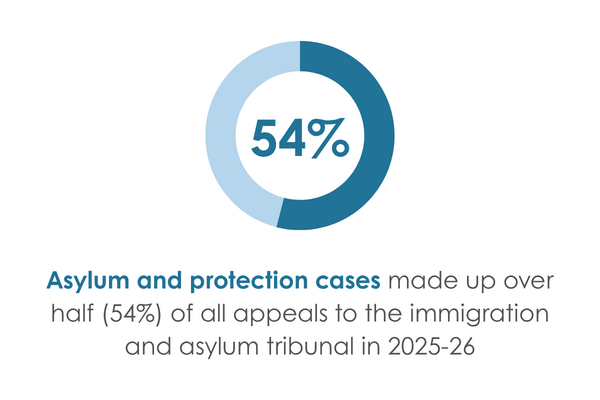
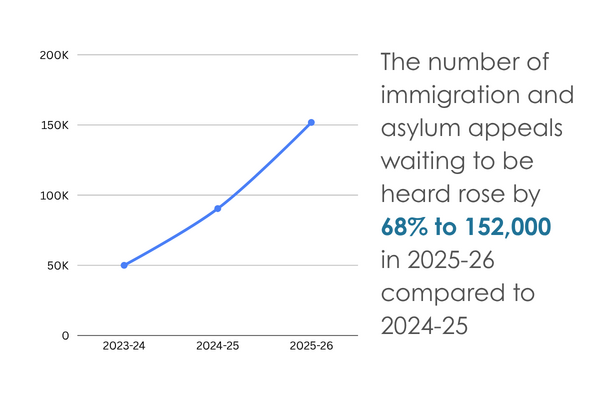
The latest Ministry of Justice figures (January to March 2026) show how often initial decisions are challenged. Asylum and protection cases made up over half (54%) of all appeals to the immigration and asylum tribunal in 2025-26, and the 15,000 received in the latest quarter is the highest quarterly total on record. Across all immigration and asylum appeals, in 2025-26 the number waiting to be heard rose by 68% to 152,000, compared to 2024-25.1
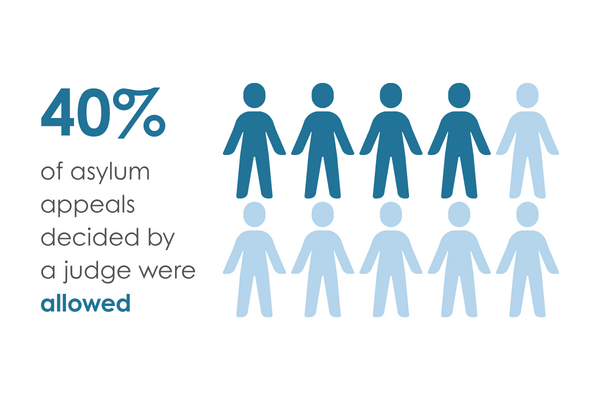
Of the asylum and protection appeals decided by a judge, 40% were allowed. On top of this, the average asylum appeal now takes 67 weeks to resolve.1 Together, these figures suggest that many initial decisions are not upheld.
A person is seeking asylum from the moment they apply to the Home Office, and if their claim is granted, they become a refugee. However, the Home Office will only grant status if they believe the person fits the 1951 UN Refugee Convention, meaning they have a well-founded fear of persecution because of their race, religion, nationality, political opinion or membership of a particular social group.2 If it is refused, they have a short deadline to appeal, and their support will end after 21 days.
The appeal goes to the First-tier Tribunal. If the judge allows it, the person is recognised as a refugee. If it is dismissed, they can ask the Upper Tribunal to review the decision, but only on a point of law.3 If an appeal fails, or none is made in time, the person is considered Appeal Rights Exhausted by the Home Office, their support ends and they have no right to work.
This does not always mean there are no options left. A person can submit a fresh claim with new evidence, and some can apply for Section 4 support (accommodation and finances provided by the Home Office) if they are experiencing destitution. Between 2015 and 2020, 14,151 people who had been refused were later granted status or leave to remain after submitting fresh claims.4
The most common reason is that the Home Office does not believe the person's account. Caseworkers look for inconsistencies, such as differences between the screening interview and the later substantive interview, or gaps in someone's history. In other cases it accepts what happened but says it does not amount to persecution, or is not linked to one of the five Convention reasons.5
Even when a person is believed, a claim can be refused because protection is said to be available elsewhere. The Home Office may say the authorities in the person's country could protect them, which often comes up when the persecutor is not the state, such as a gang, militia or family member.6 It may say they could live safely in another part of the country (internal relocation), or that they should have claimed asylum in a safe country they passed through. There is, however, no requirement under the 1951 Refugee Convention that says a person must claim asylum in the first safe country they reach.
Most of the people we support have experienced trauma, both in their home countries and on their journeys to safety. Trauma can affect memory and how a person processes information, so people may misremember dates or contradict themselves. This can lead to disbelief from the Home Office, rather than understanding of their claim.
Interpreting runs through the whole asylum process, from the substantive interview to later appointments and hearings. How accurately a person’s words are interpreted, and how they are understood, can affect whether they are believed. A mistranslated detail can look like an inconsistency, and inconsistencies are a common reason for refusal.5
Safety matters too. An interpreter from the person’s own country or region can create mistrust, especially for someone who fled persecution. One person we support told us:
"When I arrived for my first interview and saw someone from my own country there to interpret, I felt immediate fear. [...] I worried they might be working for the government or a spy. When we don't know who we are talking to, we close down, instead of opening up."
People rarely flee with documents, and a lack of identity documents or medical records can lead to refusal.7 Gathering evidence later often depends on contacts in the country of origin, which may not be possible or safe.4 For fresh claims, people may not understand why they were refused or what counts as new evidence. Homelessness can make it hard to get old case files, and a lack of money, a phone or internet can stop people arranging appointments or contacting witnesses.
It is estimated that around half of people seeking asylum have no solicitor when they open their claim, and many large providers stopped this work when fixed fees began in 2022.7 Legal aid rates are now so low that many lawyers cannot afford to do it.8 Greater Manchester Immigration Aid Unit (GMIAU) is the only not-for-profit legal aid provider in the North West. To get legal aid at appeal, a case must usually have at least a 50% chance of success, and people without the right to work can rarely afford a private solicitor.4 Some pay large sums for poor advice, often on fresh claims, and are refused again. For example, one person's solicitor did not tell them about their refusal until five days before the appeal deadline, and others lost evidence their clients had given them.4 Fresh claims are harder still, because providers can be unwilling to take on a case that has already been refused.
Without a lawyer, people face a complex appeal form, a new language and an unfamiliar legal system.4 The Immigration Law Practitioners' Association warns of a high risk of unfair procedure,8 and unrepresented appeals take judges longer.9 As someone at GMIAU told us, "bad legal representation is so damaging."
When a refusal ends asylum support, many people experience homelessness. Without a fixed address, Home Office letters are missed and appeal deadlines pass.4 Lost paperwork, the pressure of daily survival and poor health all get in the way of gathering evidence.9 Fear of the Home Office can also keep people from seeking advice. In one case, non-judgemental listening from local organisations helped several people reach GMIAU and win their status.10 We see that once people have housing and legal support, they are far more likely to re-engage with their case.
Each barrier can feed the next. A refusal ends support, homelessness makes evidence and legal advice harder to find, and a weaker fresh claim is refused again.
The Independent Chief Inspector's review of asylum casework (June to December 2025) found that quality targets for interviews and decisions had not been met for two years. It also found problems with staff morale, wellbeing and high attrition, and called for a change in culture away from an "us and them" mindset.10
Other concerns point to a culture of disbelief, with flawed credibility assessments and a starting point of disbelief rather than neutrality.8 Some people who presented evidence at interview were told they were not believed, with no clear explanation.4 This sits alongside decisions made at speed by inexperienced staff.8 Practitioners say evidence sent before interviews was not always considered, and that interviews were cut short so people could not put their case properly.9
When decisions are wrong, the cost does not disappear. Nearly half of appeals (48%) succeeded in 2024, so people are left relying on the courts for protection they were first denied.8
With help from charities, solicitors, legal aid and other support, many of those who are initially refused are still able to overcome these barriers, appeal their decisions, and successfully gain status. However, there are still cases where individuals get to the point where they cannot appeal any more, or cannot find any new evidence, and have exhausted every legal option available. This is when they either choose voluntary return, face risk of detention and enforced removal, or remain in the UK without status and face destitution and a severe risk of exploitation.
This is why support is crucial, so that these things don’t happen to anyone seeking sanctuary. Behind every refusal statistic is a person trying to find safety. With the right legal representation and practical support at the right time, those who have been wrongly refused can finally secure the protection they need.
1 Tribunal Statistics Quarterly: January to March 2025, Ministry of Justice, 2026, https://www.gov.uk/government/statistics/tribunals-statistics-quarterly-january-to-march-2026/tribunal-statistics-quarterly-january-to-march-2026
2 The 1951 Refugee Convention, UNHCR, https://www.unhcr.org/uk/about-unhcr/overview/1951-refugee-convention
3 The Right to Remain Toolkit: Appealing at the Upper Tribunal, Right to Remain, 2025, https://righttoremain.org.uk/toolkit/ut/
4 Refused? Experiences following a negative asylum decision, NACCOM, 2023, https://naccom.org.uk/new-report-refused-experiences-following-a-negative-asylum-decision/
5 A Free Guide: Your Asylum claim has been refused, Migrant Law Partnership, 2026, https://migrantlawpartnership.com/resources/your-asylum-claim-has-been-refused/
6 Why Many Asylum Claims Fail, Migrant Law Partnership, 2026, https://migrantlawpartnership.com/immigration-guides/why-many-asylum-claims-fail/
7 People who are initially refused asylum are slipping through the cracks, NACCOM, 2025, https://naccom.org.uk/blog-people-who-are-initially-refused-asylum-are-slipping-through-the-cracks-urgent-reform-is-needed/
8 Briefing: the sorry state of the UK asylum system, Free Movement, 2026, https://freemovement.org.uk/briefing-the-sorry-state-of-the-uk-asylum-system/
9 A Slow Violence, Boaz trust & GMIAU, 2024, https://hubble-live-assets.s3.eu-west-1.amazonaws.com/boaztrust/file_asset/file/935/Destitution_Report_Final_Web.pdf
10 An Inspection of asylum casework June 2025 - December 2025, Independent Chief Inspector of Borders and Immigration, 2026, https://assets.publishing.service.gov.uk/media/6a3cfd23eaee00074150f4a1/An_inspection_of_asylum_casework__June___December_2025_.pdf


